

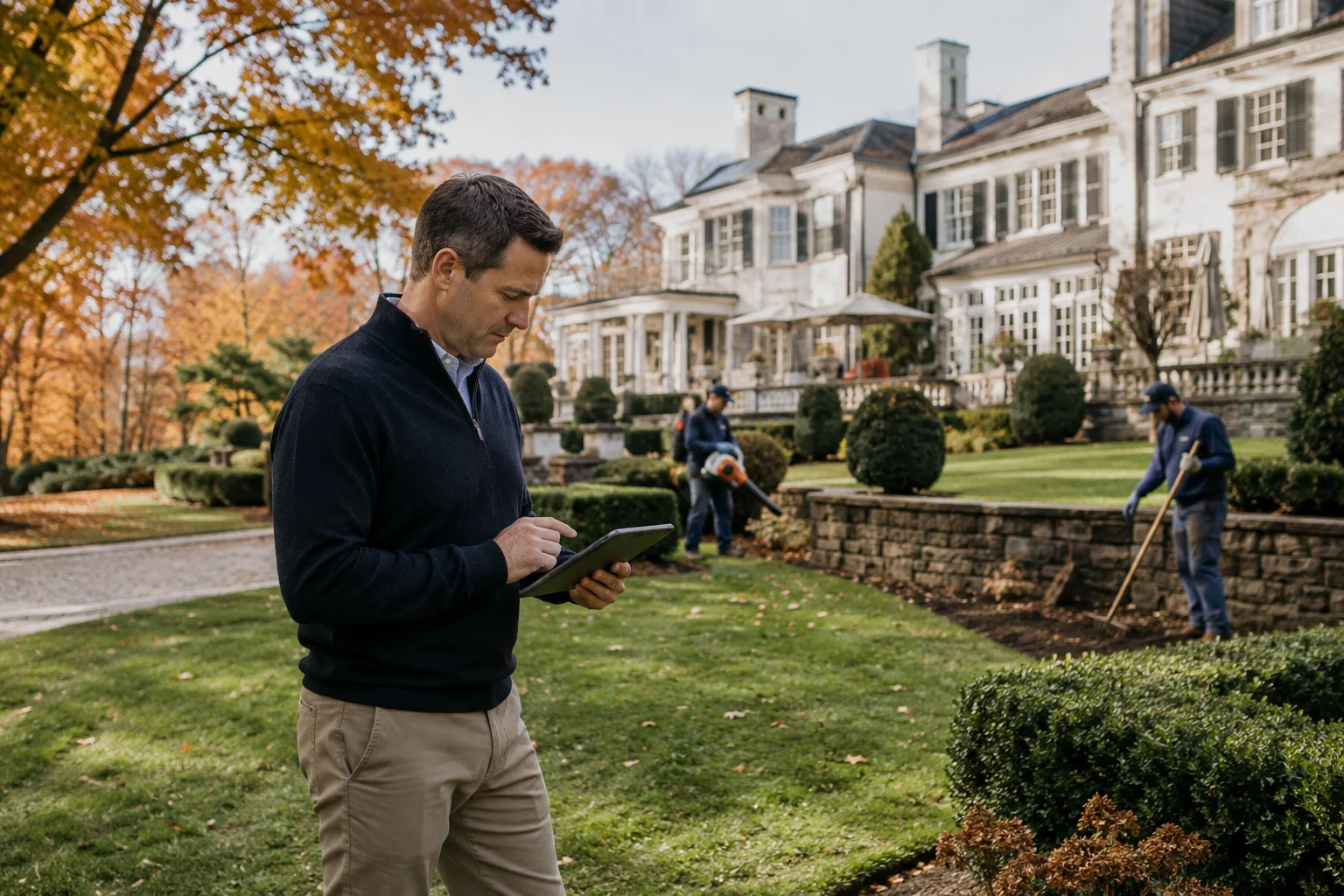
Nobody buys a large home in Fairfield County because they want another job. But at a certain level, that is effectively what ownership becomes.
This does not happen overnight. The first year is manageable. The landscaper is reliable, the HVAC company is responsive, the cleaning team has a rhythm. By the third or fourth year, the vendor list has grown, the scheduling has become more complex, and the administrative overhead of keeping everything coordinated has quietly expanded into something that requires real time and attention to maintain.
Managing a large home in Fairfield County is as much an organizational challenge as it is a maintenance one.
In Greenwich, Darien, New Canaan, Westport, and surrounding communities, most larger properties operate with somewhere between six and twelve active service relationships at any given time. Each vendor has their own schedule, their own service intervals, their own invoicing, and their own way of communicating about the property. They do excellent work within their own domain. What they do not do, and have no reason to do, is coordinate with each other.
That coordination gap is where the administrative burden lives.
HVAC servicing gets scheduled without awareness of the electrical work happening the same week. The landscaping crew wraps up a drainage project and notes a concern near the foundation wall, that note sits in an email thread and never reaches the roofing contractor who is coming in next month. A seasonal vendor who worked on the property for years retires and is replaced by someone who has no history with the property. The institutional knowledge about what has been done, what is pending, and what the property’s specific quirks are does not transfer automatically.
Over time, these gaps compound.
Maintenance history becomes dispersed across years of invoices and individual vendor memories. Seasonal transitions become harder to coordinate because nobody has the full picture of what needs to happen in what order. Small issues that were identified but not followed up on develop into larger issues that require more expensive interventions.
Centralized estate administration addresses the organizational problem at its root.
One coordinator maintains the full operational picture across service providers, schedules, and maintenance history. Vendor observations feed into a single record rather than staying siloed in individual service reports. Seasonal preparation is planned well in advance rather than assembled under deadline pressure. When a vendor rotates out, the incoming provider inherits organized context about the property rather than starting from scratch.
The administrative side of ownership also becomes more demanding as life gets busier.
Many homeowners across Fairfield County manage significant professional schedules alongside properties that require ongoing coordination. Some maintain multiple residences. Others travel frequently. As personal demands increase, informal management structures that worked when there was more time available become increasingly impractical. The property is too important — and too complex — to be managed through a combination of personal memory and reactive scheduling.
Luxury property management in Fairfield County is designed to absorb that coordination burden and return simplicity to the homeowner’s relationship with the property.
The goal is not just that the maintenance gets done. It is that the homeowner does not have to personally track whether it got done, follow up with vendors to confirm it was scheduled, or spend a weekend in October trying to figure out whether the irrigation system has been winterized. That is the work that organized estate administration handles — invisibly, consistently, and on the property’s behalf.
At Monarch Luxury, that is the work we take on. One coordinator, full visibility, and an organized maintenance history. For properties on Connecticut’s Gold Coast that have grown beyond what informal management handles well, that structure is what we are built to provide.