

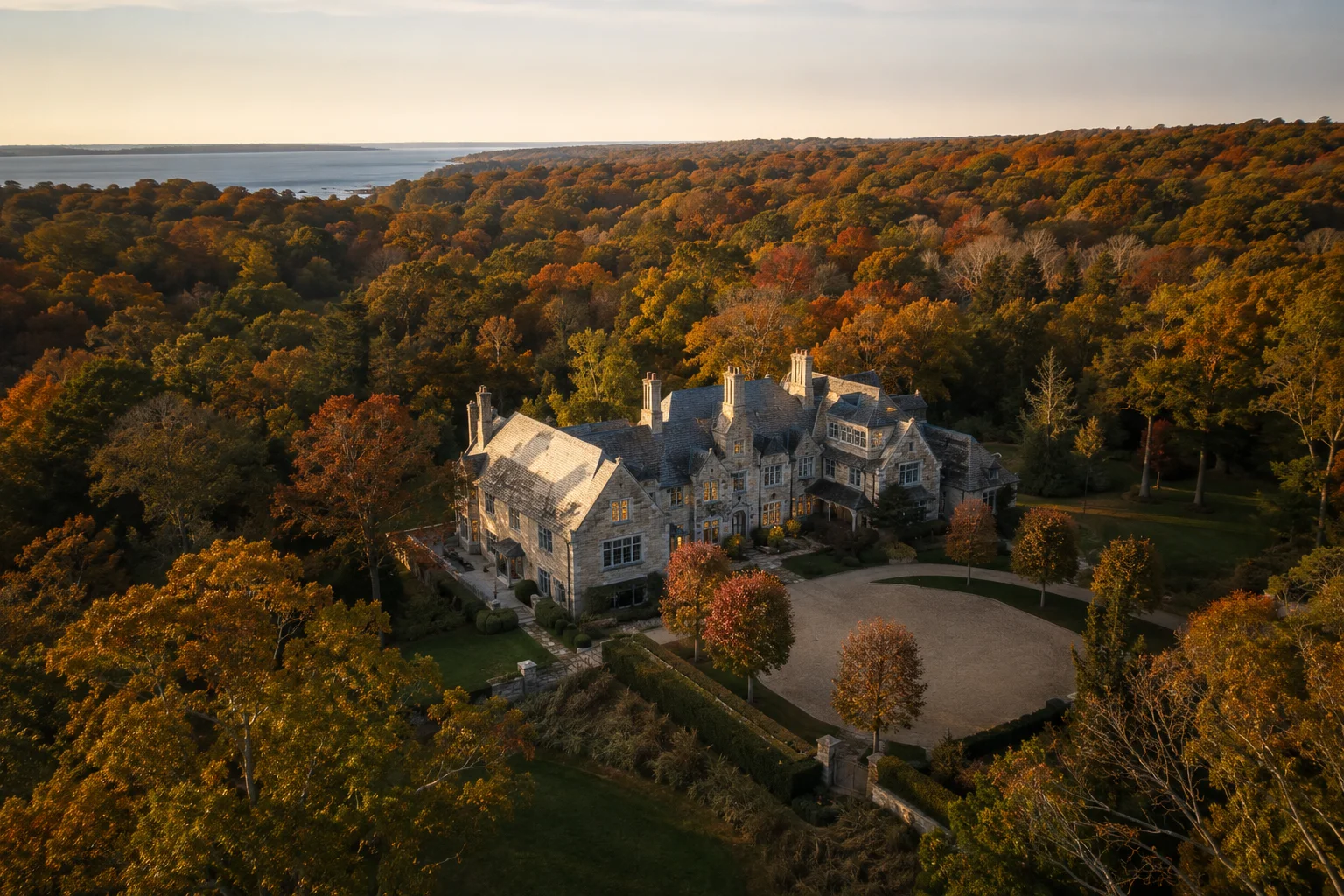
There are two houses on the same street in New Canaan that were built the same year, by the same developer, with the same materials. They are both still standing. They both look, from the road, like well-maintained homes in a well-maintained town. Up close, they tell very different stories.One has original copper flashing at every roofline transition, still tight, still doing its job.
The other had its flashing replaced eight years ago after a slow leak found its way through a failed seam and spent two winters working toward the ceiling of a first-floor study. The repair was not catastrophic. But by the time it was caught — really caught, not just patched — the project involved a roofing contractor, a finish carpenter, a painter, and six weeks of scheduling. The underlying cause was a maintenance gap that probably opened up sometime around year seven or eight. The flashing had been on nobody’s regular inspection scope. That is not an unusual story. It is actually a fairly typical one.
Twenty years is enough time for the difference between consistent oversight and reactive maintenance to become visible in the bones of a property. Not always dramatically — the gap rarely announces itself as a single disaster. It shows up as a pattern. Restoration costs that recur on a shorter cycle than they should. Systems that get replaced before their useful life is up because deferred servicing accelerated the wear. Landscape investments that never fully recovered from a drainage problem that went unaddressed for a season too long. The exterior is usually where it shows first.
Bluestone terraces and patios are a good example. On a properly managed property, grading and drainage around hardscape gets reviewed regularly, and minor shifts get corrected before freeze-thaw cycles have a chance to work on them. On a reactively maintained property, the first sign of a problem is usually a section that has started to lift or separate — at which point releveling means pulling and resetting stone, addressing whatever drainage issue caused the movement, and waiting for the right contractor window to do it properly. The work gets done. But on the New Canaan property with organized oversight, that bluestone terrace has never needed releveling. On the comparable property two streets over, it has been done twice. Roofing systems tell a similar story, especially on homes with architectural complexity.
Larger Fairfield County estates frequently involve multiple roof elevations, copper elements, custom flashing details, and integrated drainage structures. These systems age well when they are inspected at the transitions — the places where materials meet, where movement happens, where water finds its path. They age less well when inspections focus only on the visible field of the roof and miss the detail work. The difference, over twenty years, is often one full roof section and several interior restoration projects avoided on one property, paid for on the other.
The landscape is where deferred maintenance becomes most expensive, and most invisible until it isn’t.
Mature plantings, established lawn systems, and significant hardscape investment represent real money — often more than homeowners fully account for when they are thinking about property value. They also respond to management consistency in ways that are slow to show up and slow to reverse.
A drainage issue that affects a planted bed for two seasons does not kill the investment immediately. It stresses it. The recovery, if the drainage gets corrected, can take several more seasons. If the drainage doesn't get corrected — if it gets noticed but not followed up on, or if the vendor who noticed it and the vendor who could address it never communicate — the investment degrades quietly while the property looks, to a casual observer, more or less the same.
The well-managed property’s landscape at year twenty looks the way it was designed to look, because the infrastructure supporting it has been maintained consistently. The reactively maintained property’s landscape at year twenty looks like it has been through something. Because it has. Mechanical systems are perhaps the most straightforward place where the mathbecomes obvious.
HVAC equipment in larger homes has a predictable useful life when properly maintained and a noticeably shorter one when it is not. The difference is not dramatic year to year — it is cumulative. A system that runs slightly less efficiently because it missed a service interval, then runs harder to compensate, then misses another interval because the service call got pushed, does not fail on any particular schedule. It just fails earlier than it should have, usually under maximum demand, usually at the least convenient moment.
Over twenty years and across multiple systems — HVAC zones, generators, water treatment equipment, integrated climate systems in wine rooms or detached structures — the replacement cost differential between a consistently maintained property and a reactively maintained one is significant. Not because the reactive property is negligent.
Just because consistency compounds in one direction and deferred maintenance compounds in the other.
None of this is about finding fault with how any particular homeowner has managed their property. Large estates are complex, vendor relationships are difficult to coordinate, and the gap between what needs to happen and what actually gets scheduled is easy to underestimate until it has been accumulating for a few years. What twenty years makes clear is that the gap is real, and that it has a cost.
The homes in Fairfield County that are in the best condition after two decades are almost never the ones where the most money was spent on repairs. They are the ones where the least deferred maintenance was allowed to accumulate — where someone was consistently watching the full picture, connecting what one contractor observed to what another contractor needed to know, and keeping the property on a maintenance rhythm rather than a repair cycle. That is the difference. And it is visible. Sometimes from the road, always up close.